Managing heat generated by machines in a laboratory
Room temperature
The temperature of the room where the bench is installed must be between 20°C and 25°C to comply with regulations (FDA).
Otherwise, the air entering the soundproofing compartment will be too hot, and the bench’s ventilation system will not work properly.
This may cause the machines to be soundproofed to overheat.
Preliminary HVAC assessment
Ideally, when a laboratory is designed, a preliminary assessment should be carried out of the HVAC system and the needs of the different rooms.
Ultimately, the goal is to calculate the cooling capacity required to maintain the required temperature within a room.
For this calculation, the following must be taken into account:
- The geographic area (whether it is a temperate or cold climate)
- The room volume
- Lighting
- Windows
- The machines to be installed now and in the near future
- The number of technicians who will be working in it
With all this information, the following are calculated:
- Total cooling capacity
- Number of split units
- Their location
All of this to achieve the desired temperature.
In addition, for critical laboratories (pharmaceutical, biological), this calculation must be performed by a specialist engineer to comply with air renewal and HEPA filtration regulations.
A common case in laboratories
After almost 10 years of experience, the reality is quite different.
A fairly common case in laboratories is the following:
A laboratory built about 10 years ago, with a room of about 15 square meters, an LCMS unit with a vacuum pump, and one technician.
When it was built, it was determined that a split unit installed in the ceiling was sufficient to maintain an optimal temperature of around 20°C.
Over the years, the following are installed in that room:
- Two more LCMS units
- One with two fairly powerful vacuum pumps
- Another with one vacuum pump
- Two more technicians
- A gas generator
However, the room still has one split unit, which cannot maintain the temperature at 20°C.
This causes the room temperature to be around 30°C, and the equipment begins to have problems.
Possible solutions
The possible solutions for this case would be the following options:
Option 1
Recalculate the number and capacity of the split units, taking the new conditions into account.
Option 2
Move these machines that generate so much heat to another location.
This is often not possible due to space constraints.
Option 3
When the first and second options are not feasible, it is possible to extract the heat generated by the machines.
For this case, ZenBench offers manifolds to place at the fan outlets and, in turn, route this heat outside through ducts.
ZenBench manifolds
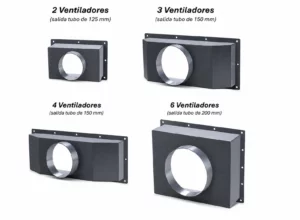
Depending on the heat generated by the machine to be soundproofed and the number of fans required to extract heat from the bench, ZenBench offers manifolds for:
- 2 fans
- 3 fans
- 4 fans
- 6 fans
Example of extracting heat to the outside
Below, we will explain how the heat generated by a vacuum pump could be vented outside.
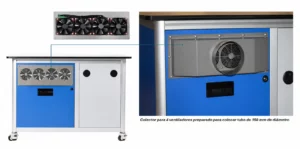
Let us assume that this vacuum pump belongs to an LCMS and is installed in a ZBench 120VP1 bench to reduce pump noise, with 4 fans exhausting all the hot air generated by the pump into the room.
Step 1: Installing the manifold
The first step is to remove the 4V plate.
For this, you only need a Phillips screwdriver.
Now place the manifold for 4 fans on top of the plate and, using the same screws, secure it to the bench.
Note If you have a powerful extraction system and the fans supplied with the bench are not required, you can connect the manifold directly to the bench, without the fans.
Step 2: Connecting the duct
The next step is to connect the duct to the manifold to route the heat outside the laboratory.
In this case, this manifold is designed to connect ducts of 150 mm diameter, so the duct is connected to the manifold using a clamp.
Recommended duct types
There is a wide variety of ducts that can be used.
To reduce pressure loss, i.e., the resistance the duct offers to airflow, it is always recommended to use:
- Smooth galvanized rigid ducts
And avoid as much as possible:
- Restrictions
- Elbows
- Obstructions to airflow
If installing metal ducts is too complicated or expensive, flexible PVC ducts can also be used, bearing in mind that they must:
- Be fire-resistant
- Withstand temperatures between -30°C and 80°C
- Be kept as stretched as possible
Step 3: Outlet to the outside
Now you simply need to route this duct outside the laboratory.
If the outlet to the outside is not close to the manifold, it is recommended to do so through the suspended ceiling.
Step 4: Circular inline duct fan
For this manifold and using a 150 mm diameter duct, it is necessary to install a circular inline duct fan about 5 meters from the manifold to draw and discharge the air to the outside.
There is a wide variety of inline duct fans.
Recommendation for this hypothetical case
For this hypothetical case, we recommend installing, in the suspended ceiling and 5 meters from the manifold, the model:
TD-500/150 3V from the TD-MIXVENT series
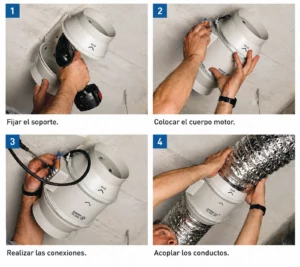
Installation is very simple.