Importance of using HPL in laboratories
What is HPL?
HPL stands for High Pressure Laminate.
High-pressure laminates, according to European and international standards EN 438 and ISO 4586, are high-density boards (≥1.35 g/cm3), finished and ready for use, which possess extraordinary mechanical and physical strength, resistance to chemical products, and are easy to work with and maintain.
HPL boards are made of cellulose-based materials (60-70%) and thermosetting resins (30-40%) subjected to both pressure (>7MPa) and heat (140 / 150 ºC) in special presses, for a fixed time that varies according to the type of laminate.
This process creates a high-density, stable, inert, homogeneous, and non-porous material with physical and chemical properties that are entirely different from those of its original components.
Furthermore, given its low permeability, HPL acts as a barrier against the possible emission of formaldehyde and other volatile organic compounds (VOCs) from any wood substrate onto which it is applied.
The history of HPL
The history of HPL dates back to 1896, when Leo Baekeland, an American chemist, combined phenol and formaldehyde to obtain a resin that could be converted into an insoluble polymer.
By adding a fine sawdust filler, he obtained a very dark plastic material that he patented in 1907 under the name Bakelite, after his surname. The precursor to modern HPL was born.
This was a material with excellent mechanical and, above all, non-conductive electrical properties, which immediately attracted the interest of the electrical industry, replacing porcelain and mica as insulating materials in electrical appliances.
However, its low resistance to light meant it could only be manufactured in black or brown, limiting its use in many markets.
Subsequently, it was discovered that these resins, mixed with cellulose and subjected to a polymerization process, produced a solid material with excellent mechanical properties, light stability, abrasion resistance, and electrical non-conductivity.
This latest discovery made it possible to produce it in a wide range of colours and finishes, making it appealing to many markets.
Why should HPL be used in laboratories?
The use of HPL in laboratories is important due to the technical properties it offers,
especially in environments where resistance, safety, and hygiene are required.
High chemical
resistance
It allows for
frequent contact with reagents, solvents, and cleaning products used in the laboratory.
Great mechanical resistance
It is
resistant to impacts, scratches, and abrasion, which helps maintain the furniture in good condition for longer.
Better performance against humidity and heat than melamine
In laboratories where equipment that generates continuous heat is used, such as mass spectrometers, HPL offers greater stability and durability.
Compact and easy-to-clean surface
It facilitates disinfection and contributes to maintaining proper hygienic conditions.
Application in laboratory furniture
It is commonly used in:
- Worktops
- Workbenches
- Cabinets
- Panels
Resistance to bacteria
HPL is more hygienic and easier to clean than common furniture finishes.
It has high resistance to the growth of microorganisms such as bacteria, mold, and fungi.
This attribute makes it ideal for applications where hygiene plays an essential role.
Hygienic
HPL surfaces are durable, compact, and highly impermeable due to the melamine resin they are made of, and they are not damaged by chemicals commonly used in laboratories.
It is a thermosetting material and does not react with these substances.
It also does not experience corrosion or oxidation and, therefore, does not require additional protective enamel or varnish.
It offers a hostile environment for the proliferation of germs and bacteria and, unlike other materials of synthetic origin, it has antistatic properties and therefore does not attract dust.
Reaction to fire
In general, HPL has an excellent reaction to fire with low smoke emissions.
In the event of a fire, it does not ignite easily (only at very high temperatures) and does not soften or spread.
In summary
HPL is a more resistant and durable solution for laboratory furniture, especially in environments with analytical equipment and demanding working conditions.
Unlike melamine, HPL offers better resistance to humidity and heat, which is particularly important in laboratories where equipment that generates continuous temperature is used, such as mass spectrometers.
These conditions can affect less resistant materials over time, while HPL maintains greater stability and durability.
HPL at ZenBench
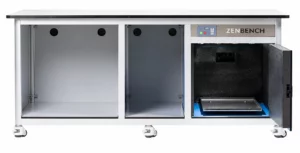
At ZenBench, we use HPL as standard throughout the entire table.
For the worktop area, we use a high-quality HPL, specifically designed for laboratories, with a thickness of 20 mm.
For all the enclosure and the floor, we use high-quality 12 mm HPL in gray and blue.
We always use blue in the soundproofing compartments.